Most content briefs start with a keyword. One phrase, one intent, one angle.
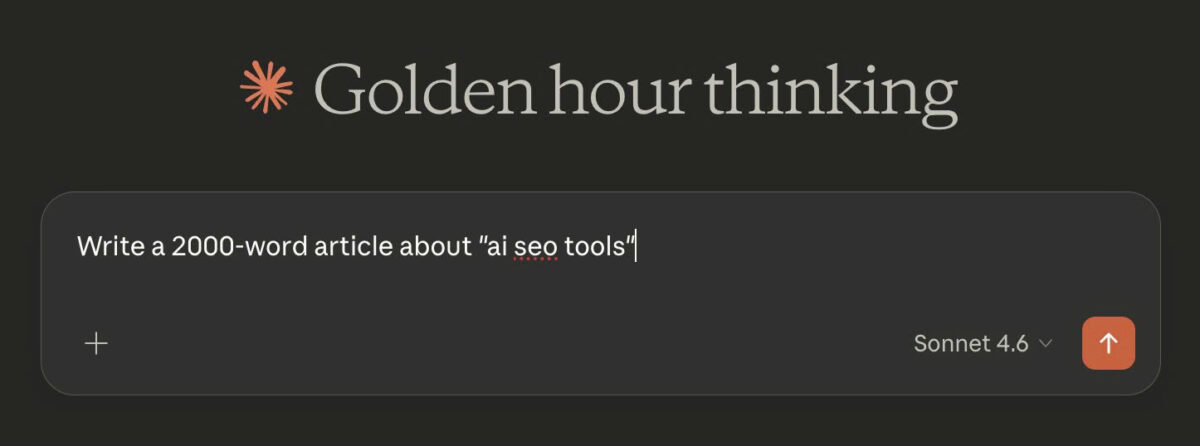
That’s not how AI search engines think.
And if you’re still briefing content that way, you’re writing for a model of search that’s already changing.
The problem with single-keyword briefs
When I started looking at how large language models handle search queries, one thing stood out.
AI search doesn’t match a query to a document. It expands the query first – into related questions, reformulations, entity expansions, sub-intents – and then looks for content that covers the full picture.
This is called query fan-out.
You can read more about query fan-out here.
Take “SEO for AI” as a seed. A single keyword. Seems narrow.
But an AI search engine processing that query is also thinking about:
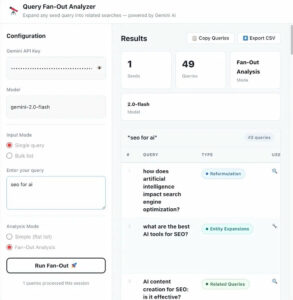
- How does artificial intelligence impact search engine optimization?
- What are the best AI tools for SEO?
- Can AI replace SEO professionals?
- How does Google use AI for ranking?
- AI SEO vs traditional SEO
- Free AI SEO tools
- How to train an AI for SEO
That’s 49 queries from one seed. Different types – reformulations, entity expansions, related questions, use-case variations. All sitting behind that one phrase.
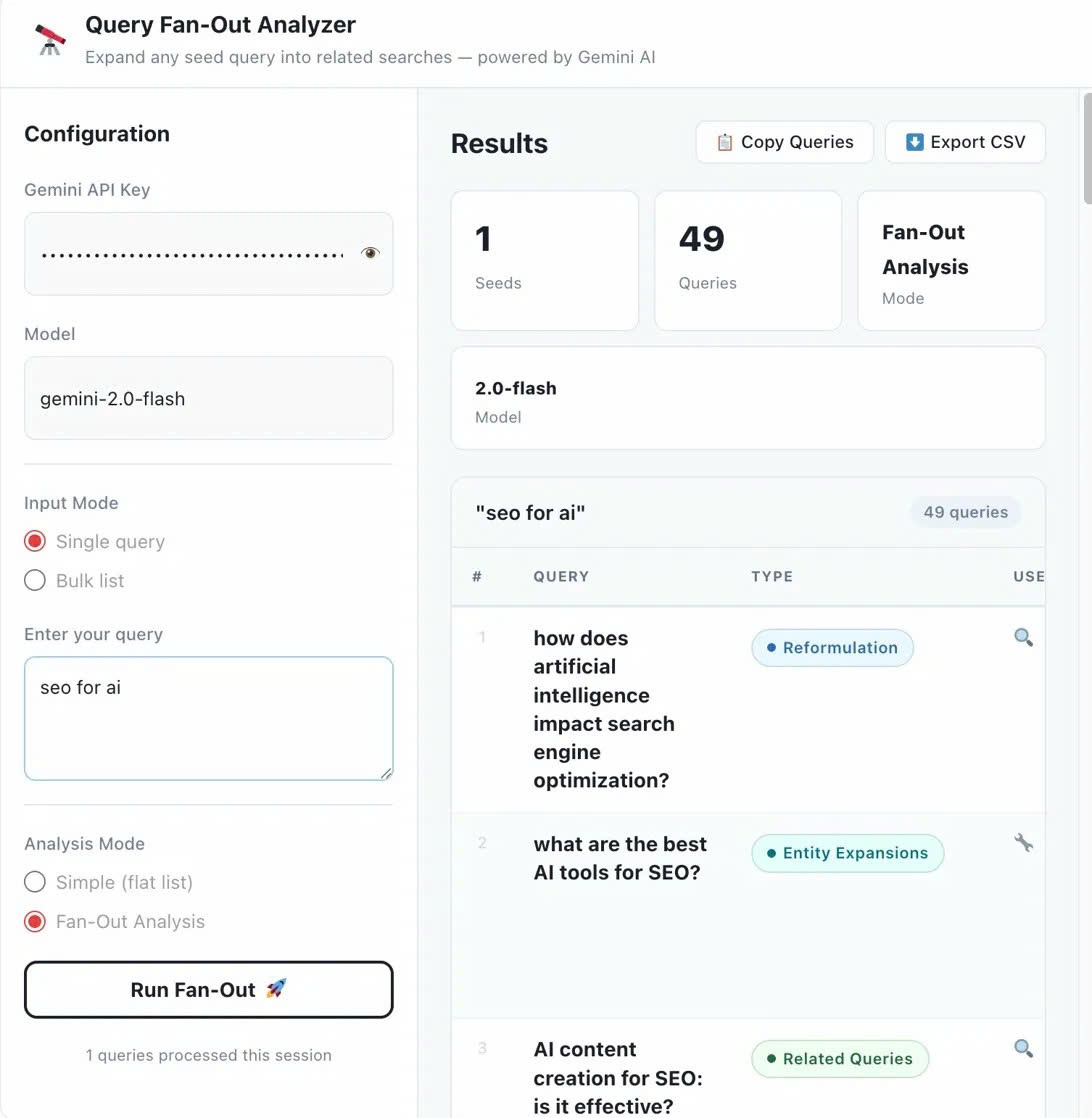
If your content only answers the seed, it answers one of 49 things the reader might actually be asking.
Why this matters for content briefing?
The brief is where content quality gets decided. Not in the writing – in the setup.
Before we write anything, my team needs to understand the full intent landscape around a topic. What questions are we answering? What entities need to be covered? What sub-topics does a thorough piece need to address?
I used to build this manually. Read the SERPs. Check People Also Ask. Look at related searches. Pull competitor outlines.
It worked. It also took 45 minutes per brief and still missed things.
Query fan-out gives you a more systematic starting point. Instead of guessing what’s related, you generate the full expansion from the seed – then use that as the backbone of the brief.
The writer knows exactly what the content needs to cover. The brief is tighter. The output is more complete.
Why I built a tool instead of just prompting
The honest answer: prompting Claude directly for query fan-out works, but it’s inconsistent. The output format changes. The query types aren’t always labeled. It’s hard to export and pass to the team cleanly.
I wanted something repeatable. Same input, same structured output, every time.
I’m not a developer. But I’ve been using Claude Code to build small tools that solve specific workflow problems – and this felt like the right use case.
I described the logic to Claude Code: take a seed keyword, generate fan-out queries, categorize them by type (reformulation, entity expansion, related query, use-case variation), and return a clean exportable list.
A few iterations later, the tool worked.
It now lives at Query Fan-out Generator. My team uses it before every content brief. It runs on Gemini 2.0 Flash, which handles the expansion well and is fast enough that it doesn’t slow the briefing process down.
How we actually use it
The workflow is simple.
Enter the seed keyword. Run the fan-out. Review the 40–50 queries it generates.
Then filter. Not every query belongs in a single piece of content. Some become H2s. Some become separate articles. Some get flagged as out-of-scope for this brief but worth tracking for future content.
What you’re left with is a map of the topic – which is a much better starting point for a brief than a single keyword and a blank page.
The writer can see the full intent landscape before they start. They know what the content needs to cover to be genuinely useful, not just keyword-present.
What this doesn’t replace
Query fan-out is a research input. It’s not the brief itself.
You still need to look at the SERPs. You still need to understand the audience. You still need editorial judgment about what angle to take and what to leave out.
The tool surfaces what’s possible. The brief decides what’s right.
And for AI-era SEO – where content needs to answer the full question, not just rank for the seed – having that map before you start is worth the 30 seconds it takes to generate it.
The broader principle
I keep building these small tools because the alternative is doing the same manual work indefinitely.
Claude Code makes it possible without a dev team. You describe the problem, iterate on the output, and end up with something your whole team can use.
Query fan-out was a 2-hour build. It’s saved that time back every week since.
That’s the math I’m working with.
Author Profile

- I’m an SEO Manager with 7+ years of experience helping brands grow through data-driven strategies. Passionate about the intersection of search, content, and technology, I blend technical SEO, analytics, and creativity to drive performance and build meaningful digital experiences.
Latest entries
 BlogApril 18, 2026How to Set Up Meta Pixel Events on Haravan via GTM?
 BlogApril 11, 2026How I Use Query Fan-Out to Write Better Content (And Built a Tool for It)
 BlogApril 11, 2026I Managed 40+ SEO Clients. Google Sheets Broke. Here’s the Notion Template I Built to Fix It.
 BlogMarch 29, 2026I Built an Agency Website in Bricks Builder as a Non-Developer. Here’s What Happened.