Most SEOs know that backlinks matter. But ask the average business owner — or even a mid-level marketer — how many links they need to rank for a specific keyword, and you’ll get a blank stare. Or worse, a confident but completely made-up number.
Backlink audits are painful. You pull the data, stare at a spreadsheet full of competitor domains, and still have no clear answer to the most important question: what does it actually take to compete?
This article walks through a simple but effective framework for calculating your backlink acquisition targets — and introduces a free calculator you can use to plan your link building like a professional.
The Problem With Traditional Backlink Audits
The typical backlink audit goes something like this: you open Ahrefs or SEMrush, look at what your competitors have, feel vaguely overwhelmed, and move on with your day. Maybe you note that Competitor A has 80 referring domains and Competitor B has 60. But that raw number doesn’t tell you much.
Here’s what gets missed:
Not all backlinks are created equal. A single DR 70 link from a major industry publication can outweigh twenty DR 15 links from random directories. If you’re only looking at link counts, you’re ignoring half the equation.
Averages without context are misleading. If the top-ranking competitors for a keyword average DR 17.2 with 10 referring domains, that tells a different story than DR 17.2 with 80 domains. The effort required is completely different.
There’s no clear KPI. Most audits end with a vague recommendation to “build more links.” That’s not a strategy — it’s a wish.
A Better Framework: Link Equity
The concept that makes this approach work is link equity — a weighted measure of your backlink profile that accounts for both the quantity and quality of your links.
The formula is straightforward:
Link Equity = Number of Referring Domains × Average DR
So if your competitors rank with 10 links averaging DR 17.2, their target equity is 172 points.
Your job isn’t necessarily to match their exact link count — it’s to match (or beat) that equity score. That means 7 links at DR 25 gets you 175 equity points and achieves the same threshold with fewer, higher-quality links.
This shifts the conversation from how many links do I need to what mix of links gets me there most efficiently.
Breaking It Down by DR Tier
The real power comes from breaking your plan into DR tiers. Instead of thinking about links as a single bucket, you plan across ten ranges:
- DR 0–10 (midpoint: 5)
- DR 10–20 (midpoint: 15)
- DR 20–30 (midpoint: 25)
- DR 30–40 (midpoint: 35)
- DR 40–50 (midpoint: 45)
- DR 50–60 (midpoint: 55)
- DR 60–70 (midpoint: 65)
- DR 70–80 (midpoint: 75)
- DR 80–90 (midpoint: 85)
- DR 90–100 (midpoint: 95)
Each tier has a midpoint value used in the equity calculation. When you enter how many links you plan to acquire in each tier, the calculator automatically sums up your total equity and compares it against the target.
This lets you model different scenarios. If you’re working with a limited budget and have access to a few high-DR opportunities, you can see exactly how those stack up against acquiring a larger number of mid-tier links. You make decisions based on math, not gut feel.
How the Calculator Works
The HairFolli Backlink Gap Calculator (available as a free Excel download) applies this framework across 13 target keywords pulled from real competitor data.
For each keyword, the sheet shows:
- Avg DR — the average domain rating of referring domains in the competitor set
- # Links — the number of referring domains competitors have acquired
- Target Equity — automatically calculated as Avg DR × # Links
- Your Equity — updates in real time as you fill in your planned links per DR tier
- Coverage % — how close you are to matching competitor equity
- KPI Status — a simple ✅ MET / ⚠️ CLOSE / ❌ NEED MORE indicator
The yellow input cells are the only thing you need to fill in. Enter how many links you plan to acquire in each DR tier for each keyword, and everything else calculates automatically.
The totals row at the bottom gives you a portfolio-level view — a full picture of your link building roadmap across all target keywords in one place.
A Practical Example
Take the keyword best hair growth products australia. Competitors rank with an average DR of 17.2 across 10 referring domains, giving a target equity of 172 points.
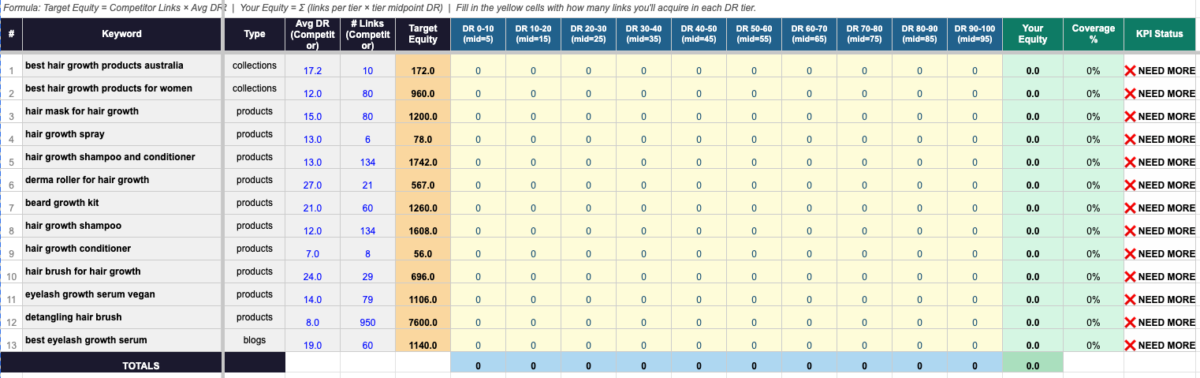
If you’re building links through outreach and partnerships, you might realistically target DR 20–30 placements. At a midpoint of 25, you’d need just 7 links to hit 175 equity — clearing the target with fewer, better-quality placements than your competitors are using. That’s a meaningful insight for how you prioritise your outreach.
Compare that to detangling hair brush, which has 950 referring domains at DR 8. The equity target is 7,600 points. Even if you build DR 20 links, you’d need 380 of them. That’s a signal to either deprioritise this keyword, target it through content rather than pure link building, or plan a very long runway.
An Important Disclaimer
This framework is a planning tool — not a ranking guarantee.
Backlinks are one of the most significant factors in Google’s algorithm, but they’re one of over 200 signals that influence rankings. Technical SEO, page speed, content quality, user experience, topical authority, and dozens of other factors all play a role.
Reaching your target equity for a keyword improves your competitive position and makes ranking more achievable — but it doesn’t guarantee it. Search is complex, and results vary based on your domain’s overall authority, the freshness of your content, and how aggressively competitors continue to build links after you do.
Use this calculator to set realistic, data-backed acquisition targets. Use it to prioritise which keywords are worth pursuing now versus later. But keep it as one input in a broader SEO strategy, not the whole strategy itself.
Build Your Own Version With AI
If you want to try building something similar for your own keywords, here’s the prompt we used to create this calculator. It’s not perfect out of the box — you may need to tweak the formatting or adjust the logic to suit your data — but it’s a reasonable starting point.
You’ll need your keyword list with average DR and referring domain counts from Ahrefs or SEMrush. Once you have that, paste the prompt below into Claude or ChatGPT and replace the example table with your own data:
The prompt we used:
I need you to build a Backlink Gap Calculator as an Excel (.xlsx) file.

Here is my keyword data:

| Keyword | Avg DR (competitor) | # Referring Domains (competitor) | Type |
|---|---|---|---|
| [keyword 1] | [avg DR] | [# links] | [page type] |
| [keyword 2] | [avg DR] | [# links] | [page type] |
[add more rows as needed]

Build the spreadsheet with the following logic:

1. For each keyword, calculate Target Equity = Avg DR × # Referring Domains
2. Add 10 input columns for DR tiers: DR 0-10, DR 10-20, DR 20-30, DR 30-40, DR 40-50, DR 50-60, DR 60-70, DR 70-80, DR 80-90, DR 90-100. Use the midpoint of each tier (5, 15, 25, 35, 45, 55, 65, 75, 85, 95) for calculations.
3. Calculate Your Equity = sum of (links entered per tier × tier midpoint DR)
4. Calculate Coverage % = Your Equity ÷ Target Equity
5. Add a KPI Status column: ✅ MET if coverage ≥ 100%, ⚠️ CLOSE if ≥ 70%, ❌ NEED MORE if below 70%
6. Make the DR tier input cells yellow so I know what to fill in
7. Add a totals row at the bottom showing total links planned per tier
8. Use professional formatting with frozen panes on the keyword column

All calculations should use Excel formulas, not hardcoded values.
Results will vary depending on your data and how the AI interprets the instructions. It may take a couple of attempts to get the formatting right, but the underlying logic should hold. If you get stuck, feel free to reach out — we’re happy to help.
Download the Calculator
The HairFolli Backlink Gap Calculator is a free Excel file pre-loaded with 13 keywords across collections, product pages, and blog content. It works with any Ahrefs or SEMrush data — just update the Avg DR and # Links columns with your own keyword targets.
Fill in the yellow cells, watch the coverage percentage climb, and build links with a clear KPI in front of you for the first time.
No more guessing. No more vague recommendations. Just a number, a tier breakdown, and a plan.
Disclaimer: This article was written with the help of AI. The ideas, experience, and lessons shared here are entirely my own.
Author Profile

- I’m an SEO Manager with 7+ years of experience helping brands grow through data-driven strategies. Passionate about the intersection of search, content, and technology, I blend technical SEO, analytics, and creativity to drive performance and build meaningful digital experiences.
Latest entries
 BlogApril 11, 2026How I Use Query Fan-Out to Write Better Content (And Built a Tool for It)
 BlogApril 11, 2026I Managed 40+ SEO Clients. Google Sheets Broke. Here’s the Notion Template I Built to Fix It.
 BlogMarch 29, 2026I Built an Agency Website in Bricks Builder as a Non-Developer. Here’s What Happened.
 BlogMarch 10, 2026I Built My Own WordPress Auto Internal Linking Plugin – Here’s Why and How